Security Controls.jpg
An official website of the State of Georgia.
The .gov means it’s official.
Local, state, and federal government websites often end in .gov. State of Georgia government websites and email systems use “georgia.gov” or “ga.gov” at the end of the address. Before sharing sensitive or personal information, make sure you’re on an official state website.
Still not sure?
Call 1-800-GEORGIA to verify that a website is an official website of the State of Georgia.
In accordance with the Information Security Control Policy, each agency operating within a Shared Services Environment is responsible for ensuring that applicable NIST SP 800-53, Security and Privacy Controls for Information Systems and Organizations (current published version), aligned to the State-adopted baseline, are implemented and operated effectively. This standard establishes responsibilities for security controls per application and/or system operating within a Shared Services Environment, including systems hosted in Third-Party and cloud-based environments. The standard also establishes the minimum baseline for periodic security control reviews, assessments, and technical testing as well as audits by the State Department of Audits and Accounts (DOAA).
This standard applies to systems hosted on-premise, within shared State facilities, or in cloud-based environments including Software as a Service (SaaS), Platform as a Service (PaaS), and Infrastructure as a Service (IaaS), as well as systems operated by third-party service providers.
Agencies and Service Providers (including Managed Service Integrators (MSI)) shall comply with all applicable security controls outlined within the standard in accordance with NIST SP 800-53, Security and Privacy Controls for Information Systems and Organizations (current published version).
Security controls shall be categorized, consistent with NIST SP 800-53 guidance, as Common Controls, Hybrid Controls or System-Specific Controls.
Control categorization shall be documented within system-level security documentation.
The applicable control families are listed below:
| Technical Controls | Operational Controls | Managerial Controls |
| AC - Access Control | AT - Awareness Training | CA - Security Assessment /Authorization |
| AU - Audit & Accountability | CM - Configuration Management | PL - Planning |
| IA - Identification & Authentication | CP - Contingency Planning | RA - RiskAssessment |
| SC - System & Communication Protection | IR - Incident Response | SA - System& Services Acquisition |
| SI - System & InformationIntegrity | MA - Maintenance | PM – Program Management |
| MP - Media Protection | PT – PII Processing & Transparency | |
| PE - Physical & Environmental Protection | SR – Supply Chain Risk Management | |
| PS - Personnel Security |
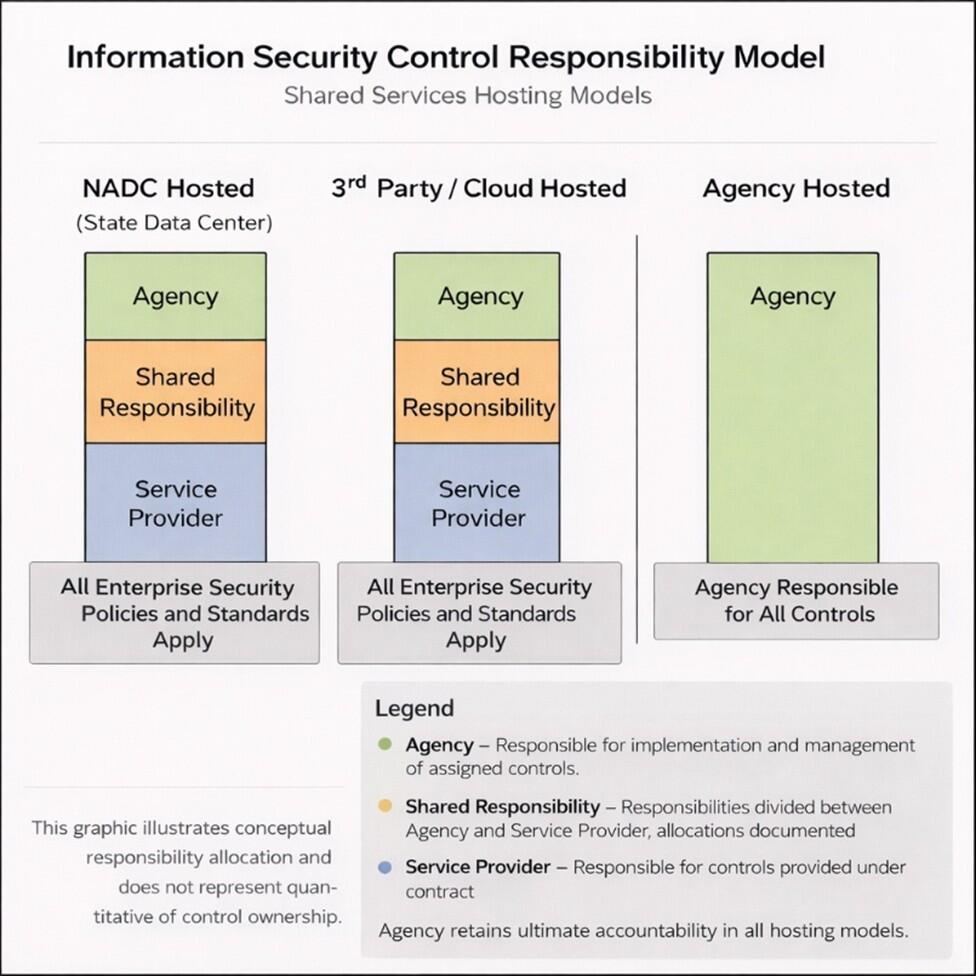
The Information Security Control Responsibility Model – Shared Services Hosting Models (Figure A-1) below, provides a perspective of shared responsibilities for Agencies, Service Providers, and MSI across the State’s IT enterprise. It also defines responsibility across hosting models, including Third-Party and Cloud-Based Hosting Models.
Although an agency may not have technical responsibility for certain controls under Shared Services Hosting Models, the agency retains ultimate accountability for compliance requirements.
For systems where security is provisioned, implemented, and maintained solely by agency staff, Figure A-1 responsibility allocations do not apply; however, this standard and other enterprise IT standards remain applicable.
Figure A-1: Information Security Control Responsibility Model – Shared Services Hosting Models
Agencies may request an exemption from the implementation of any enterprise information technology policy or standard by submitting an exemption form to [email protected]. The exemption must be approved by the State Chief Information Officer (CIO) with review by the State Chief Information Security Officer.
In each case, the agency or vendor must include such items as:
An exemption request cannot be reviewed unless all residual risks have been identified and the Agency leadership has provided approval, indicating acceptance of these risks. Exemption requests must be re-evaluated periodically, and extension requests are required after one year.
Risk Management Framework Standard (SS-08-041)
Information Security Infrastructure Standard (SS-08-005)
Independent Security Assessments Standard (SS-08-042)